Last Updated on July 1, 2026 by David
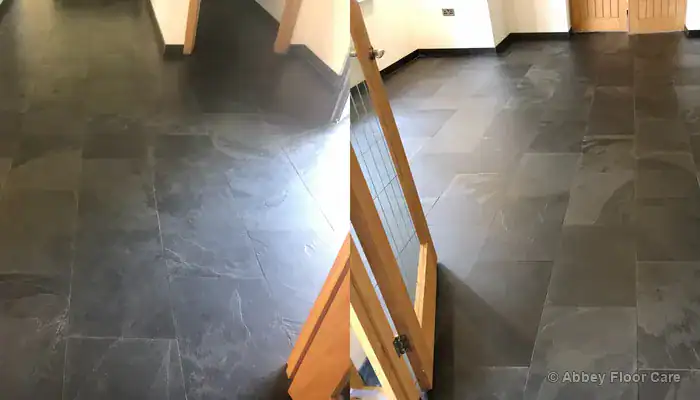
This case study from Abergavenny illustrates a large, textured riven slate floor that consistently trapped dirt, resulting in a tiresome cycle of stripping and re-waxing. Our intervention involved removing the old coatings and implementing a robust, protective sealing system.
What Underlying Factors Contributed to the Maintenance Difficulties of the Wax-Finished Slate Floor in Abergavenny?
The Daily Challenges Faced by the Homeowner
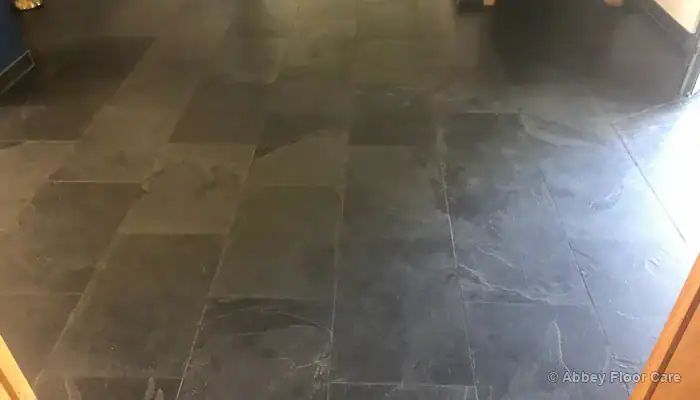
When a Brazilian slate floor is only visually appealing immediately following a complete strip and re-wax, it indicates the surface finish is inadequate for routine maintenance. The homeowner in Abergavenny encountered this very issue: the floor looked stunning post-restoration, but daily family life quickly dulled its shine, demanding prompt attention once more.
Covering more than 1,500 square feet of slate, this was no trivial weekend task. Each restoration effort involved managing a significant expanse of natural stone tiles, carefully addressing edges, navigating shared living spaces, and dealing with the inevitable disruption associated with coating such an extensive domestic floor.
With two large dogs constantly moving in and out, the floor’s finish needed to perform optimally, unlike in a quiet home with minimal traffic. Muddy paws, loose debris, and wet conditions necessitated constant cleaning between wax applications—especially as the textured riven surface highlighted marks much more than a smooth floor would.
The picturesque homes of Abergavenny and the surrounding NP7 region encompass Victorian terraces, Edwardian semi-detached houses, historic stone cottages, and modern kitchen extensions. Slate is a popular and durable choice for these properties, often found in high-traffic areas like entrance halls, boot rooms, utility spaces, and expansive open-plan kitchen-diners.
These designs typically channel heavy foot traffic, wet footwear, and pets through the same pathways. Over time, older subfloors or the junctions between original rooms and new extensions can create uneven moisture conditions, causing the slate to appear dull, patchy, or dirty as traditional sealers deteriorate.
Strategies for Effectively Maintaining a Large Slate Floor
Managing a waxed floor that extends across multiple interconnected rooms significantly amplifies the effort required to keep it looking presentable. While a small entryway may be manageable with some patience, a vast area of sealed slate becomes overwhelming as the finish begins to wear unevenly.
The stone itself was not the issue; Brazilian slate is remarkably durable and practical for a bustling household. The main concern was the high maintenance demands associated with the traditional wax finish over such a large area.
The natural riven texture added another layer of complexity. The stone is mechanically split along its natural layers during production, resulting in attractive ridges and valleys. While this characteristic enhances the slate’s unique charm, it also complicates daily cleaning, requiring attention to a highly textured surface rather than a flat, smooth plane. The homeowner’s straightforward goal was to have a floor that remained cleaner for longer, responded well to regular mopping, and did not necessitate a disruptive restoration process each year.
How to Break the Cycle of Extensive Maintenance
When stripping and re-waxing is the only method to achieve an acceptable appearance, routine cleaning shifts from being genuine maintenance to merely postponing the inevitable. This was the core problem we needed to address. The homeowner did not desire a different flooring style; they simply wanted an attractive surface that could be maintained with minimal effort.
Initially, the old wax routine provided the slate with a traditional, mid-lustre finish that suited the home well for a time. Given the extensive square footage and the daily dirt tracked in by the two large dogs, that annual maintenance cycle swiftly became unmanageable.
This project exemplifies a common challenge faced by many homeowners across the UK. If you are trying to understand why your own floor is losing its shine, investigating issues with faded slate floors can clarify how colour, coating wear, and stone texture interact. In this instance, the soft wax finish itself became the main issue by trapping dirt rather than repelling it.
As natural slate varies beautifully in colour, thickness, and texture, a large floor will never appear completely uniform like a synthetic product. Our objective was to preserve all the natural character of this Brazilian stone while replacing the high-maintenance finish with a more manageable solution. A professionally restored and properly sealed floor is significantly easier to clean than a worn or improperly treated one, which is why we opted for a modern, protective approach for this home.
How Layered Wax Accumulation Transforms Regular Floor Care into an Annual Chore
Applying a fresh layer of wax over an existing one results in a buildup of sealant, rendering daily maintenance laborious. On this floor, years of accumulated coatings resulted in a substantial build-up along the walls, in corners, and within the lower troughs of the stone, creating a patchy and uneven surface even after a thorough clean.
The wax had become a burden to remove, rather than a surface worth preserving.
While the old wax provided a classic, traditional appearance, its soft nature meant it easily trapped debris under the paws of the family dogs. This situation contrasts with intentionally selecting a specific aesthetic, which is detailed in our guide on wet-look slate finish options. In this scenario, the priority was not merely a deeper colour—it was about breaking a frustrating maintenance cycle that failed to deliver reliable stain protection or a consistent sheen.
The Comprehensive Process for Removing Old Wax and Preparing the Slate Surface
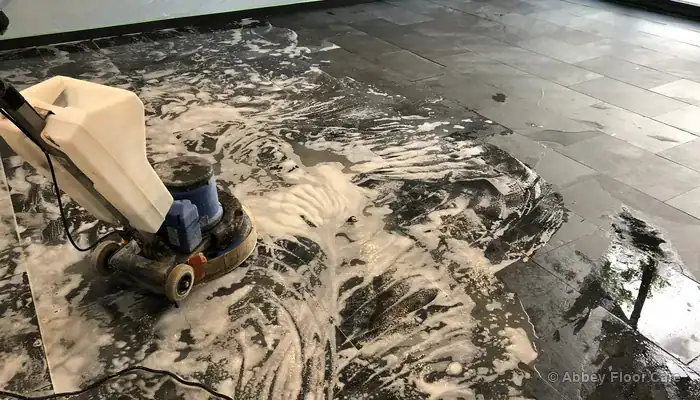
Applying a new sealer over old wax leads to failure, as the new finish cannot bond appropriately to the stone. To ensure success, we needed to completely eliminate all traces of the old coating and extract any chemical residues before considering a new sealer.
Here’s how we executed the restoration process:
| Stage | Action Taken | Importance of Each Step |
|---|---|---|
| 1. Protect | We carefully masked and safeguarded the home’s delicate oak skirting boards and surrounding walls. | This ensures your woodwork remains completely safe from any chemical or water splashes. |
| 2. Break Down | We applied a specialized sealer remover and agitated it across the floor using a heavy-duty rotary scrubbing machine. | This liquefies the years of stubborn, built-up wax trapped in the slate’s texture. |
| 3. Detail | We meticulously scrubbed all tight corners, awkward tile edges, and deep grout lines by hand. | This ensures a deep, uniform clean in the intricate areas that large machines cannot reach. |
| 4. Extract | We utilised professional, pressurised rinse-and-capture machinery to flush and vacuum away the liquefied waste. | This removes the dirty slurry completely, leaving the stone perfectly clean and chemically neutral. |
| 5. Dry | The entire 1,500 square foot area is left to dry completely overnight before any sealing begins. | This guarantees there is absolutely no trapped moisture to interfere with the new protective coat. |
Slate is a fine-grained metamorphic rock that splits beautifully along natural planes, but its layered structure means it cannot be mechanically polished like marble. Instead, its beauty relies entirely on deep cleaning and proper sealing, making it highly sensitive to harsh or inappropriate chemicals.
Our approach for this project is grounded in over 30 years of hands-on stone restoration experience. While you can explore the general principles of this work in our guide on cleaning and sealing slate floors, this particular project was guided by a clear, practical plan: remove the failing wax, deep-clean the slate and grout, and apply a durable sealer that can withstand the demands of busy family life.
Transforming the Slate Floor into an Effortlessly Maintainable and Welcoming Living Space
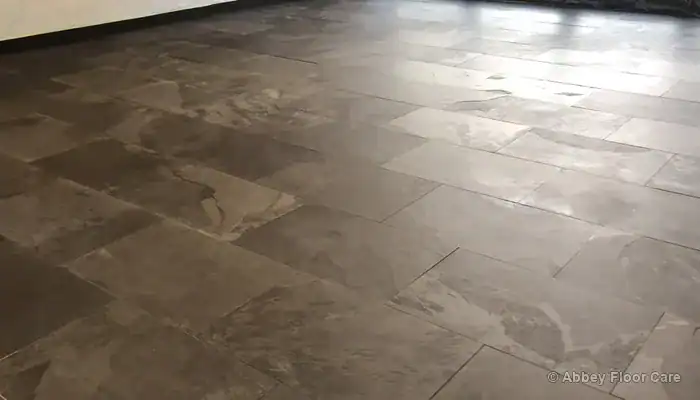
When your sealed slate responds beautifully to a simple mop, floor care transforms from an annual obligation into a straightforward task. To ensure this homeowner had a floor that did not rely on an annual re-waxing cycle, we applied two coats of Cee-Tech urethane film-forming sealer.
Unlike an impregnating sealer that penetrates the stone and leaves the surface porous, a high-performance topical sealer like Cee-Tech creates a strong, protective barrier. It fills the microscopic pores of the slate, forming a smooth, durable shield that evens out the finish into a uniform, low-sheen luster while still showcasing the stone’s beautiful, natural riven texture.
This new urethane finish completely revolutionised the floor’s maintenance routine. As dirt and abrasive garden grit now rest on top of the resilient protective film instead of embedding into the stone or grout lines, cleaning up after the dogs has become incredibly straightforward.
The longevity of your floor hinges on simple, proper care: using a pH-neutral cleaner, sweeping up loose grit before mopping, and avoiding steam cleaners (which can soften protective coatings and force moisture into the stone). For a detailed breakdown of these steps, please refer to our slate floor cleaning maintenance guide.
The homeowner was thrilled with the transformation, as the floor is now easy to live with. By adhering to our tailored care advice—mopping with a well-wrung damp cloth, using clean water, and the appropriate cleaning products—this high-performance finish will maintain its stunning, natural appearance for years to come.
Essential Tips for Homeowners with Sealed Slate Floors
Understanding how to clean and protect your slate is crucial for its longevity. While this Abergavenny project demonstrates the advantages of moving away from a high-maintenance wax routine, our guide on slate floors in UK homes delves into how stone origin, texture, and sealer options influence your long-term care strategy.
It is important to note that imported natural stones, such as Brazilian Black or Brazilian Grey slate, can behave quite differently compared to dense, traditional Welsh slate. Variations in porosity affect how a stone absorbs moisture and sealers, which is why appropriate care always depends on your specific floor rather than generic advice.
If you wish to compare this project with similar homes we’ve restored, feel free to explore our case studies on slate cleaning and sealing in Priddy and slate floor care in Matlock. These real-world examples illustrate how factors such as old coatings, deep grout lines, hard water stains, and heavy garden traffic shape the way we clean and protect your stone.

David Allen — Abbey Floor Care
David Allen has been restoring and sealing natural stone floors across the UK for over 30 years with Abbey Floor Care. This Abergavenny case study demonstrates how a large Brazilian slate floor was successfully revitalised by eliminating a burdensome wax cycle and protecting it with a high-performance Cee-Tech urethane sealer.
Is Your Slate Floor Becoming a Maintenance Nightmare?
If you find yourself trapped in a frustrating cycle of stripping and re-waxing just to keep your stone looking acceptable, we can assist you. We specialise in safely removing failing old finishes and applying high-performance, long-lasting protective systems tailored to fit your home and lifestyle.
Schedule a No-Obligation Slate Floor Assessment
The Article Slate Floor Restoration in Abergavenny first appeared on https://www.abbeyfloorcare.co.uk
The Article Slate Floor Restoration Services in Abergavenny appeared first on https://fabritec.org
The Article Slate Floor Restoration in Abergavenny Services Was Found On https://limitsofstrategy.com